India’s next premium CA firms will not be built by adding benches and branches. They will be built by owning a problem, earning trust, and handling cross-border complexity without drama.
Premium CA firms are no longer defined by how many people sit on payroll or how many services appear on the pitch deck. In practice, the market has started using a harsher test. Can the firm solve a high-stakes problem, can it defend that answer if challenged, and can it stay useful when the client’s facts spill across tax, regulation and borders? That shift is visible in boardrooms, founder circles and even affluent salaried households. The premium has moved away from visible bulk and toward scarce judgment.
Why specialization now compounds faster than scale
The backdrop matters. India’s latest official data still describes a large, formalising and fast-moving economy. MOSPI’s February 2026 estimates put real GDP growth for FY 2025-26 at 7.6 per cent and nominal GDP growth at 8.6 per cent. The Economic Survey’s January 2026 highlights showed gross GST collections of ₹17.4 lakh crore in April-December 2025, with e-way bill volumes up 21 per cent year on year. Then came the direct-tax reset: the Income-tax Act, 2025 took effect from 1 April 2026, the Income-tax Rules, 2026 were notified in March, and the department explicitly framed the shift as simplification without a change in underlying policy. That combination tells a clear story. Plain-vanilla compliance is getting cleaner. Edge-case advisory is getting richer.
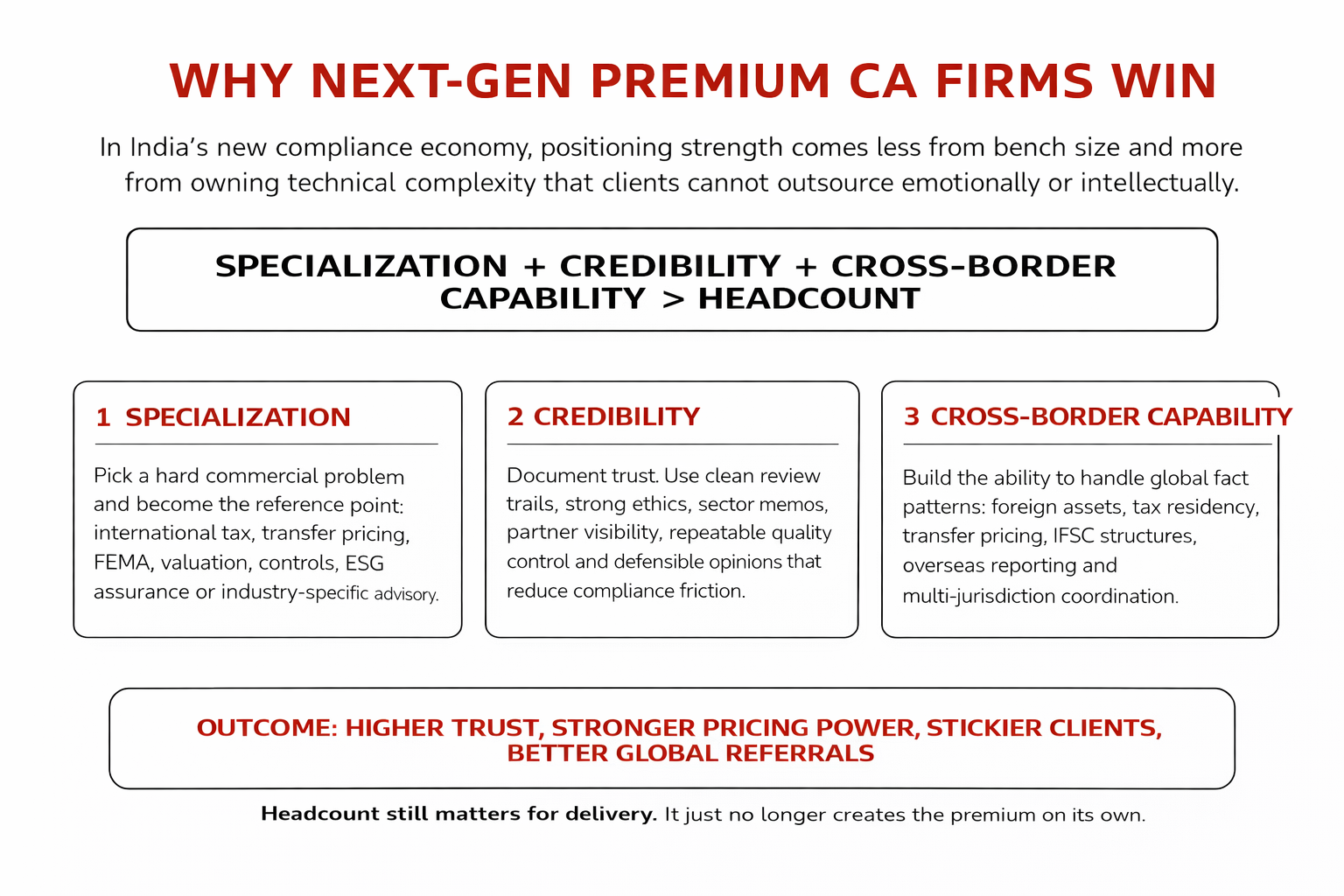
That is exactly why specialization beats breadth. As the self-assessment architecture becomes more legible for ordinary cases, fee pools do not disappear; they migrate toward ambiguity. The salaried executive with ESOPs, foreign assets or a residency question does not need a giant team. She needs someone who has seen the fact pattern before. The founder raising offshore capital, the exporter managing withholding friction, the family office dealing with FEMA boundaries, and the mid-market company facing transfer-pricing or permanent-establishment risk are all buying the same thing: reduced error at moments when error becomes expensive. Generalism struggles here because it converts every difficult file into a fresh research exercise. A specialist converts it into repeatable judgment.
Credibility has become infrastructure, not decoration
Credibility is the second half of the premium equation, and it has become more systematised. ICAI’s December 2025 reform package matters here for reasons that go well beyond professional housekeeping. The revised Code of Ethics became applicable from 1 April 2026, converged with the 2024 IESBA Code, tightened certain independence expectations, and expanded the recognised menu of advisory services into newer domains such as AI-related services, social impact assessment and forensic work. In the same reform cycle, ICAI approved the Global Networking Guidelines, 2025, explicitly to give Indian firms a structured route to international affiliations and collaborations. It also reported that UDIN generation crossed the 10-crore mark in 2025. Read together, these are not cosmetic changes. They are trust infrastructure.
That matters because credibility now scales revenue more efficiently than sheer staffing. Corporate clients, lenders and investors increasingly prefer opinions that can survive diligence, not just meet a filing deadline. A firm with a tight review culture, documented positions, sector memos, clean partner visibility and a reputation for restraint can often command better economics than a much larger shop built on volume. For the Indian middle class too, the value proposition has changed. A family making a foreign remittance, holding overseas equity or planning a return to India is not really buying compliance labour. It is buying sleep. In advisory markets, that kind of comfort belongs to firms whose names signal reliability before the file is even opened.
Cross-border capability is becoming the new premium layer
Cross-border capability is where the gap between premium firms and commodity firms will widen fastest. Official commerce data for April-February 2025-26 estimates India’s services exports at US$387.93 billion, up from US$351.93 billion a year earlier, with a services trade surplus of US$200.96 billion. Total exports of goods and services during the same period were estimated at US$790.86 billion. Meanwhile, the government’s own November 2025 profile of GIFT IFSC said the centre hosted more than 1,034 registered entities, 38 banks and an asset base of US$100.14 billion. None of this means every CA firm must become a multinational network. It does mean far more Indian clients now live inside cross-border fact patterns than many practitioners admit.
This has second-order effects everywhere. For companies, it raises the value of firms that can connect domestic tax, FEMA, accounting presentation, treaty logic and global reporting without passing the client through five separate advisors. For professionals, it changes the route to premium positioning: a smaller firm with a credible cross-border desk can look sharper than a much larger local generalist. For households, it changes who gets trusted on life events that no longer fit old domestic templates. An NRI return, a remote-work residency split, an RSU vesting cycle, a foreign broker statement, an overseas inheritance or a GIFT IFSC structure all require coordination across rules that don’t sit neatly in one chapter or one statute. This is exactly the terrain where a focused firm can look world-class without being physically large.
Headcount still matters, but only after the proposition is sharp
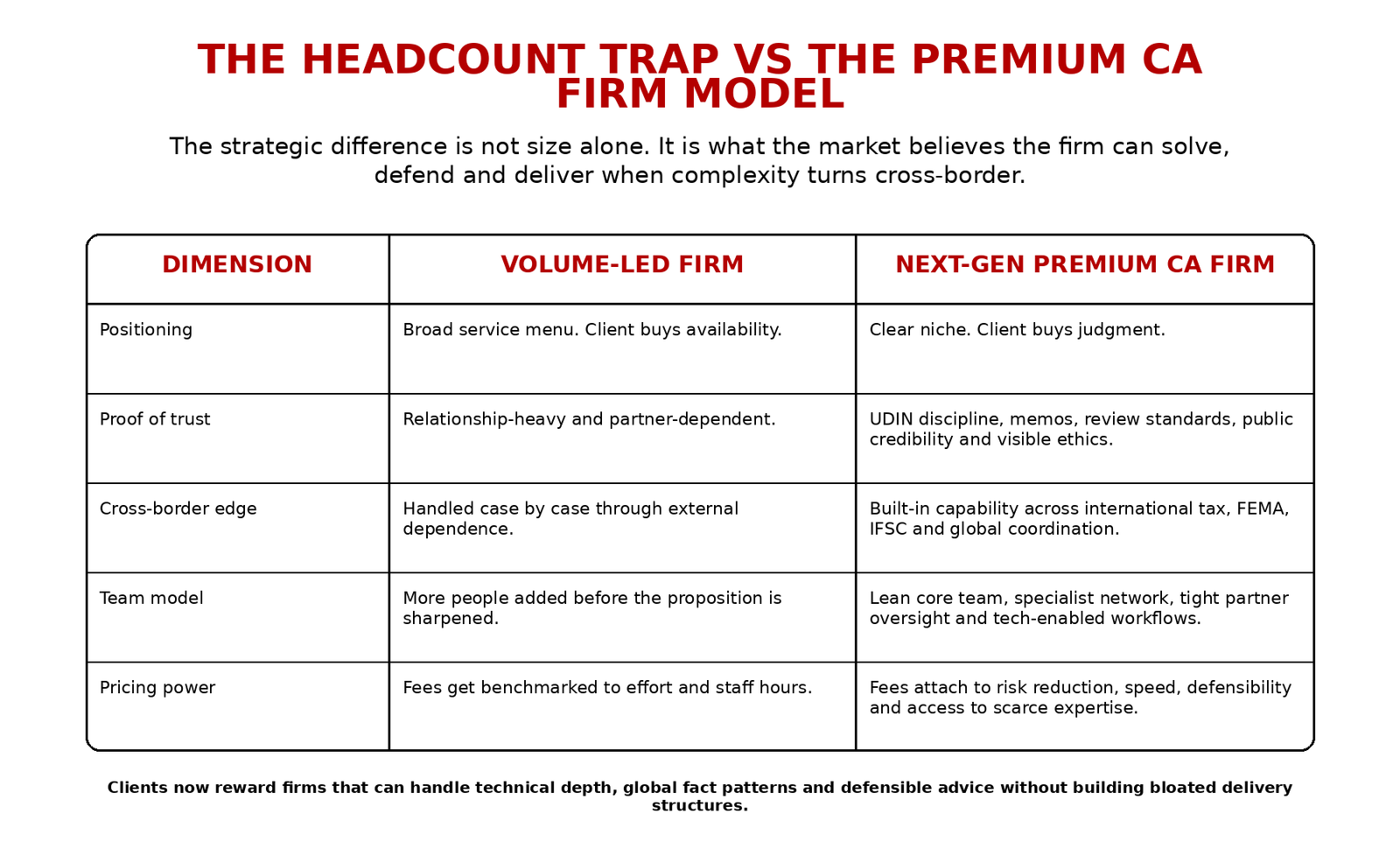
None of this is an argument against scale. Headcount still matters for delivery, succession and resilience. But it works as a lever, not as a thesis. The next generation of premium CA firms will probably look more like tightly run specialist platforms than old-style full-service partnerships. They will keep a narrow set of lead capabilities, invest in writing and review standards, publish enough to signal expertise, and use technology to strip low-margin repetition out of compliance work. They will build referral corridors rather than pretend to do everything in-house. In that model, branding is not vanity. It is a market shorthand for competence under pressure.
The firms that win the next decade will understand a simple commercial truth: clients do not pay premium fees to admire headcount. They pay when a firm lowers uncertainty, absorbs complexity and protects decision-making at moments that carry real financial, reputational or regulatory risk. In India, the policy environment is quietly pushing the market in that direction. Tax law has been simplified at the mass end. Professional ethics and networking rules have been modernised. Cross-border business has deepened. Even company-law filing is now being discussed in the language of rationalisation and lower friction. That is why the most valuable CA firms of the next cycle may not be the biggest. They may simply be the clearest about what they know, the strongest on why they can be trusted, and the fastest at handling the world beyond the border.
SOURCES & DATA POINTS
1.MOSPI / PIB — Second Advance Estimates of GDP for FY 2025-26: real GDP growth 7.6%, nominal GDP growth 8.6%. https://www.pib.gov.in/PressReleasePage.aspx?PRID=2233518&lang=1®=3
- Economic Survey 2025-26 highlights — GST collections of ₹17.4 lakh crore in April-December 2025 and cumulative e-way bill volume growth of 21% year on year. https://static.pib.gov.in/WriteReadData/specificdocs/documents/2026/jan/doc2026130774501.pdf
- Income Tax Department press release — Income-tax Act, 2025 came into force from 1 April 2026; framed as a simplification and modernisation effort. https://www.incometaxindia.gov.in/documents/d/guest/press-release-income-tax-act-2025-comes-into-force-from-01-april-2026-pdf
- CBDT notification — Income-tax Rules, 2026 notified on 20 March 2026. https://www.incometaxindia.gov.in/documents/d/guest/en-notified-it-rules-2026-20-03-2026-pdf
- Official text — Income-tax Act, 2025 [as amended by Finance Act, 2026]. https://www.incometaxindia.gov.in/documents/d/guest/income_tax_act_2025_as_amended_by_fa_act_2026-pdf
- Ministry of Commerce & Industry — India’s services exports at US$387.93 billion in April-February 2025-26; services trade surplus at US$200.96 billion; total exports at US$790.86 billion. https://www.commerce.gov.in/wp-content/uploads/2026/03/PIB-Release.pdf
- PIB / Government of India — GIFT IFSC profile: 1,034+ registered entities, 38 banks, and asset base of US$100.14 billion (as of September 2025). https://www.pib.gov.in/PressNoteDetails.aspx?ModuleId=3&NoteId=156234&id=156234&lang=1®=3
- ICAI press release, 12 December 2025 — Global Networking Guidelines, 2025 approved; revised Code of Ethics; UDIN crossed 10 crore. https://www.icai.org/post/prc-icai-press-release-12-12-2025
- ICAI President communication — revised Code of Ethics applicable from 1 April 2026 and global-alliance framework for Indian CA firms. https://icai.org/post/23745
- Union Budget 2026-27 key features — fiscal deficit in RE 2025-26 estimated at 4.4% of GDP, signalling continuing pressure on tax administration quality and fiscal prudence. https://www.indiabudget.gov.in/doc/bh1.pdf
- PIB, 17 April 2026 — MCA invited public comments for reviewing the Companies (Incorporation) Rules, 2014 and rationalising the filing framework under the Companies Act, 2013. https://www.pib.gov.in/PressReleaseDetail.aspx?PRID=2252805&lang=1®=1