TallyPrime Release 7, launched on December 19, 2025, isn’t just an upgrade—it’s a signal that India’s SME accounting stack is finally catching up with the country’s regulatory ambition.
Ask any accountant managing a mid-size Indian manufacturing firm what their December looks like, and the answer rarely involves celebration. It involves reconciliation anxiety, missed Input Tax Credits, frantic calls to vendors about e-Invoice mismatches, and the nagging dread of a GST portal that has its own opinions about what your books say. Tally Solutions seems to have been listening. TallyPrime Release 7.0, dropped on December 19, 2025, is the most structurally significant update the Bengaluru-based software company has rolled out in years—and the simultaneous release of TallyPrime Edit Log Release 7 makes the compliance story even more pointed. Whether it fully earns that billing is worth examining honestly.
India’s 63 million-odd MSMEs are the pressure point against which this release must be judged. GST-registered MSMEs grew from roughly 5 lakh in FY2017–18 to approximately 1.5 crore by December 2024, according to data tracked by ET Edge Insights—a formalization surge that has been simultaneously a growth enabler and an operational nightmare. Research published in the International Journal of Financial Management and Economics (2025) found that 88–90% of MSMEs face systemic filing inefficiencies, with annual compliance overheads for manufacturing units estimated between ₹13–17 lakh when staff time, consultant fees, and opportunity costs are factored in. The compliance burden isn’t abstract. It bleeds cash.
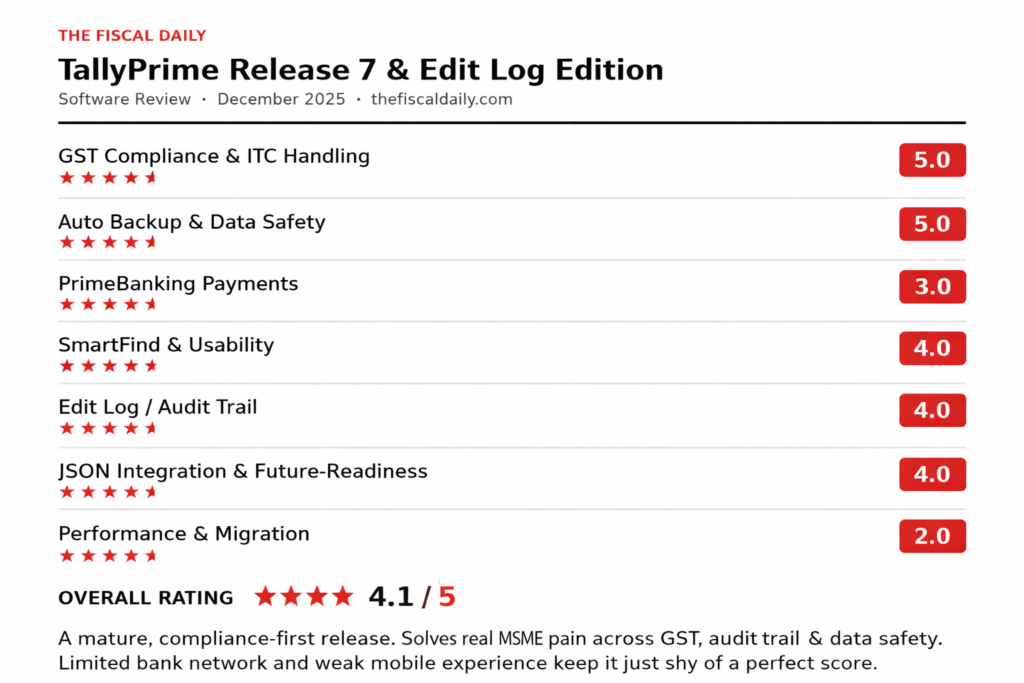
TallyPrime 7.0 leads with what Tally calls Auto Backup—scheduled, automated data backup that runs whether or not the software is open, storing files either locally or on TallyDrive, its cloud storage layer. Backups can be password-protected with a recoverable key shared with designated email IDs, and users receive alerts when a backup fails. This sounds unglamorous until you consider how many small business owners have experienced the particular horror of a corrupted Tally data file two weeks before a GST audit. The feature eliminates a category of operational risk that was entirely dependent on human discipline—or the lack of it. For CA firms managing dozens of client companies, the centralized backup management interface alone justifies an upgrade conversation.
The second headline feature is PrimeBanking Payments, which brings direct vendor payment capability inside TallyPrime, initially covering Kotak Mahindra Bank, Axis Bank, and SBI. The integration allows users to set single-transaction and daily payment limits, get real-time payment status updates, and auto-generate payment advice to suppliers. Before this, the workflow for any accountant was a miserable loop: record the transaction in Tally, open net banking separately, execute the payment, manually update bank reconciliation, pray the amounts matched. That loop is now shorter. The second-order effect is less visible but economically meaningful: faster vendor payment cycles reduce the working capital drag that has made MSME cash flows so fragile, particularly after GST 2.0’s inverted duty structures locked up refunds for entire sectors. A SIDBI survey from May 2025 estimated the MSME sector’s addressable credit gap at approximately ₹30 lakh crore, or roughly 24% of total requirement—tight payment cycles and reduced reconciliation friction are one part of addressing that systemic squeeze.
SmartFind is the feature most users will actually notice first. It’s a cross-company, cross-module search that works even when you don’t remember the exact name or spelling of a ledger, stock item, or transaction. In a country where vendor names get entered differently by different staff across different periods, this isn’t a luxury—it’s a time-saving device that removes one of the most tedious friction points in daily accounting workflows. Tally’s own documentation (TallyHelp, Release 7.0 notes, December 2025) describes it as searching “across all loaded companies,” which means it’s useful precisely in the high-volume CA firm context where multiple company files are open simultaneously.
The GST compliance updates in Release 7 are where the real operational weight lies. The ITC reduction feature in IMS (Invoice Management System) is now direct and portal-synced—after a credit note is processed, the declared ITC values sync live with the GST portal and appear in TallyPrime’s GST reports. Users can add remarks to pending or rejected invoices inside IMS and exchange those remarks with the portal. The ability to cancel e-Invoices and e-Way Bills directly from within a voucher, and to export the full period GSTR-3B in a single file, may seem like incremental improvements. They aren’t. Each of these previously required separate portal visits, copy-pasting data, and manual cross-verification. The error surface was enormous. Reducing that surface doesn’t just save time—it reduces the audit exposure that comes from mismatched records between a company’s books and the GST portal.
The JSON Data Exchange capability is arguably the most forward-looking addition. TallyPrime now imports and exports in JSON format alongside existing Excel and XML options. For most SME users, this is transparent. For developers, integration partners, and the growing fintech ecosystem that uses GST data to underwrite working capital loans—a trend confirmed by research showing GST has helped expand MSME credit access by roughly 20% year-on-year—this is a structural unlock. It means Tally data can now talk to external APIs without the lossy translation that Excel-based integration always involves. The long-run implication is that TallyPrime data becomes a cleaner input for cash flow underwriting, automated reconciliation platforms, and compliance-as-a-service layers that are rapidly building atop India’s GST infrastructure.
The TallyPrime Edit Log Release 7 deserves its own paragraph because it isn’t simply a feature toggle—it’s a distinct product edition with a regulatory mandate behind it. The Ministry of Corporate Affairs notification under the Companies Act requires companies using accounting software to maintain an audit trail, a rule that became operative from April 1, 2023. The Edit Log edition has this feature permanently enabled and non-disableable. Every creation, alteration, and deletion across vouchers and masters is logged with a timestamp, user identity, and a field-by-field before-and-after comparison. As documented on Tally’s official help portal, the log cannot be altered or removed even by an administrator. For companies that have been treating audit trail compliance as a checkbox exercise rather than a genuine data governance requirement, the Edit Log edition makes non-compliance structurally impossible. That’s not a small thing in an environment where forensic accountants and tax officers are increasingly sophisticated about what doctored books look like.
Performance improvements round out the release. Tally’s documentation notes faster company loading, report generation, printing, and export across both single-user and multi-user setups. The migration architecture has also been reworked: users can now migrate from TallyPrime 2.1 or earlier, or from Tally.ERP 9 Release 5.0, without taking their business offline during the process—a “Pause & Resume” migration pattern that removes a historically significant barrier to upgrades. In high-volume environments with years of legacy data, this isn’t a minor convenience.
Where does Release 7 fall short? A few gaps are worth naming. The PrimeBanking integration, powerful as it is, currently covers only three banks—a limited network that will leave users of HDFC, ICICI, and smaller regional banks waiting. The SmartFind feature, while practically useful, doesn’t yet extend to detailed content within voucher narrations, which is where a lot of contextual accounting information lives. Early-adopter feedback across partner forums has flagged occasional UI inconsistencies between the browser-based and desktop versions—a known rough edge in major version releases that Tally has historically smoothed out in subsequent point releases. And there’s still no mobile dashboard with meaningful functionality, a gap that becomes harder to justify as competitors build lightweight apps for business owners who want a P&L glance on their phones. These aren’t dealbreakers; they’re the legitimate complaints of users who have higher expectations precisely because the rest of the product has matured.
The pricing structure remains tied to an active Tally Software Services (TSS) subscription—users without a current subscription must renew to access Release 7.0. For businesses that have let their TSS lapse, this is a cost conversation that deserves an honest ROI calculation: weighed against ₹13–17 lakh in annual compliance overhead and the risk of a single costly audit discrepancy, the renewal math is rarely unfavorable.
TallyPrime Release 7 isn’t a radical reimagining of the software. Tally doesn’t do radical—it does steady and thorough, and there’s a large base of SME accountants who have learned to trust exactly that cadence. What this release does is close a cluster of workflow gaps that have been generating real costs in real businesses for years: data loss risk, payment friction, GST portal mismatches, cross-company search, and audit trail integrity. Done together, they add up to a meaningful operational upgrade. For the chartered accountant managing 80 clients, the manufacturing MSME facing ITC reconciliation pressure, and the compliance officer who needs tamper-proof audit logs, Release 7 earns its upgrade.