In the eight years since GST rewired India’s indirect tax system, the software that sits between a business and its compliance obligations has become load-bearing infrastructure—and Zoho Books knows it.
Picture a founder in Pune running a mid-sized e-commerce operation. She isn’t a chartered accountant. She doesn’t have a finance team. What she has is a monthly deadline to file GSTR-3B, a growing list of suppliers whose Input Tax Credit she can’t afford to lose, and the gnawing suspicion that her current spreadsheet-based workflow is one bad formula away from a ₹10,000 penalty. This is the precise market that Zoho Books has spent nearly a decade trying to own. The question worth asking in 2025—now that the GST Council has pushed through the most significant tax rate overhaul since GST’s 2017 launch—is whether Zoho Books has earned that ownership, or merely occupied the space.
The backdrop matters enormously. The 56th GST Council Meeting, held on September 3, 2025, replaced India’s four-tier GST structure (5%, 12%, 18%, 28%) with a streamlined two-tier framework of 5% and 18%, adding a 40% luxury and sin goods slab effective September 22, 2025. According to Zoho’s own academy and official GST FAQs published post-council, the 12% and 28% slabs are being phased out, credit note matching requirements have been eased, and individual life and health insurance now attracts nil GST. That’s a structural disruption affecting every item master, every recurring invoice, and every HSN code configuration in every accounting system in the country. How software responds to that moment reveals a great deal about its architecture. Zoho Books pushed an automated migration banner inside the platform, allowing businesses to schedule bulk HSN-linked rate updates without manual intervention. For the Pune founder with 400 SKUs and no accountant, that single feature justified her subscription renewal.
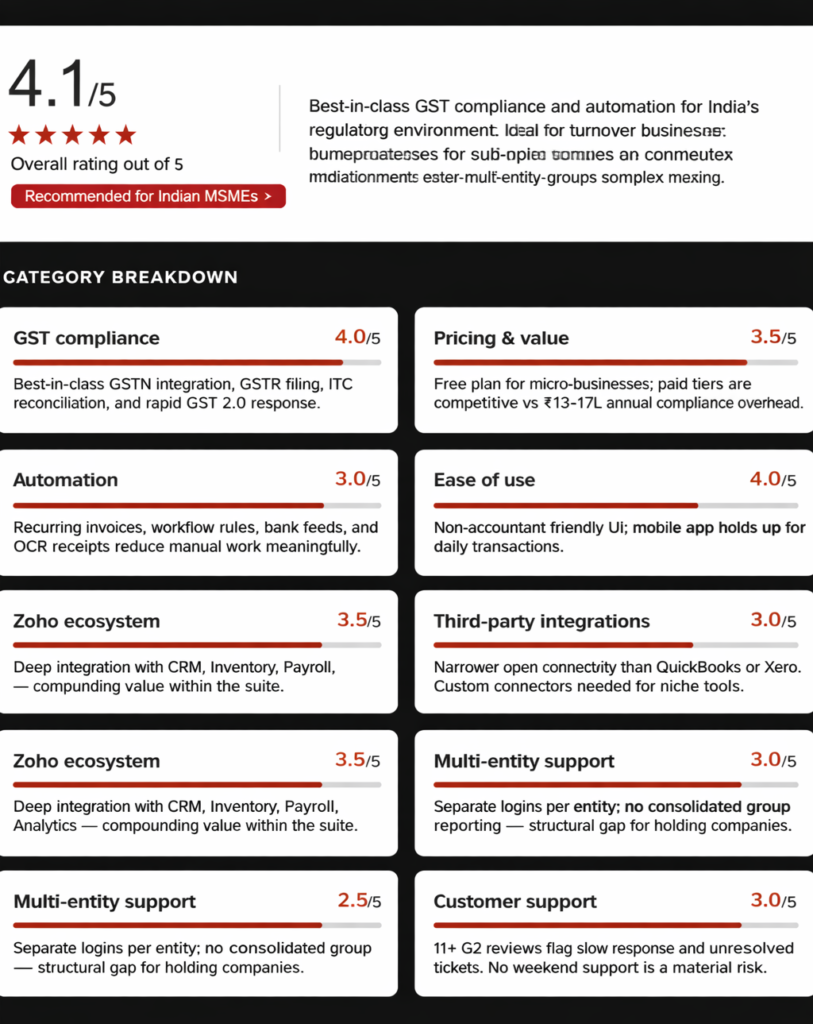
That GST 2.0 response is the strongest version of Zoho Books’ argument for itself: it’s a platform built for the Indian regulatory environment specifically, not a global product with India bolted on. As a registered GST Suvidha Provider (GSP), Zoho connects directly to the GSTN, meaning GSTR-1, GSTR-2B, and GSTR-3B can all be filed from within the software without portal-hopping. The GSTR-2B reconciliation engine compares purchase entries against supplier-filed data on the portal, flagging discrepancies before they become denied ITC claims. For businesses where working capital is tight—and the SIDBI survey of May 2025 estimated the MSME sector’s addressable credit gap at ₹30 lakh crore—every rupee of ITC recovered on time is a direct liquidity injection. The e-invoicing module handles B2B invoice authentication via the Invoice Registration Portal for businesses above the mandatory ₹10 crore annual aggregate turnover threshold, while also supporting voluntary adoption for smaller firms seeking credibility with large-scale buyers.
The pricing structure is where Zoho Books makes its most audacious play. The Free Plan, available indefinitely to businesses with annual revenue under ₹25 lakh, offers full GST-compliant invoicing, up to 1,000 invoices annually, 25+ financial reports, e-way bill generation, and delivery challan support. It’s not a stripped demo—it’s a working product. For GST-registered businesses with turnover under ₹1.5 crore, the plan is accessible directly via the GSTN website, a tie-up that positions Zoho as a de facto public infrastructure partner. The Standard plan starts at ₹899 per month and allows three users with up to 5,000 invoices; the Professional plan at the next tier adds a second GSTIN and 10,000 annual invoices; the Premium and Elite plans scale up to 25 users and 100,000 invoices annually. The marginal cost of adding a user is ₹150 per month on annual billing. Relative to the ₹13–17 lakh annual compliance overhead that research published in the International Journal of Financial Management and Economics (2025) attributes to GST management in manufacturing MSMEs, the total-cost-of-ownership argument for a paid Zoho plan is easy to make.
The Zoho ecosystem integration is the product’s secret multiplier—and also its biggest structural risk. Zoho Books doesn’t exist in isolation. It’s one module in a suite that includes Zoho CRM, Zoho Inventory, Zoho Payroll, Zoho Analytics, and over 45 other products. When the suite works together, the compounding effect is real: a sales order in CRM flows into an invoice in Books, which triggers an inventory update and a payment webhook, all without human handoffs. A CA firm reviewed on Zoho’s own platform reported 20% year-on-year revenue growth after moving to the Zoho Finance suite. The risk is that this coherence is largely intra-Zoho. The third-party integration ecosystem—measured against QuickBooks’ or Xero’s open connectivity—is narrower. Businesses that rely on niche ERPs, manufacturing-specific tools, or specialized logistics platforms may find themselves building custom connectors via Zapier or API, which adds cost and fragility.
The automation layer deserves more credit than it typically gets in standard reviews. Recurring invoices update automatically to new GST rates post-September 22, 2025—no manual intervention required for child invoices generated after the rate change date, as confirmed in Zoho’s official FAQ. Workflow rules can auto-approve vendor bills below a threshold, flag overdue receivables for follow-up, and trigger payment reminders at configurable intervals. Bank feeds connect to major Indian banks and auto-categorize imported transactions, reducing reconciliation from a weekend chore to a thirty-minute daily task. Expense scanning via OCR removes manual entry for receipts. These aren’t headline features—they’re the connective tissue that determines whether a non-accountant actually stays compliant without a CA’s daily involvement.
The honest critique section cannot be avoided. G2 reviews, aggregated through early 2025, flag three recurring failure modes. Customer support responsiveness is the most-cited complaint: 11 separate mentions of slow response and unresolved tickets in G2’s synthesized review data, and support is unavailable on weekends—a material gap for a business owner filing on a Sunday deadline. Multi-entity management is genuinely limited; the platform manages multiple companies as separate organizations with separate logins, not through a consolidated group reporting view. For a promoter running three entities within a corporate group, this isn’t a workflow inconvenience—it’s a structural deficiency. Complex GST scenarios involving job work, reverse charge on imports, or unusual supply chain configurations can outpace the platform’s automated logic, occasionally forcing manual portal uploads that undercut the software’s core value proposition.
Inventory management warrants its own caution flag. The built-in inventory module tracks stock levels, sets reorder points, and integrates with invoicing cleanly. What it doesn’t do well is serve businesses with multi-warehouse complexity, batch tracking for perishables, or production-stage costing for manufacturers. Businesses in those categories will need Zoho Inventory as a separate subscription—₹2,999/month at the Standard tier—or will find themselves in a partial solution that handles financials well but leaves operations exposed. The second-order cost of stitching two Zoho modules together, including setup time and per-user pricing, can surprise founders who enter expecting an all-in-one solution at a single price point.
The mobile experience, by contrast, is better than its reputation. The iOS and Android apps allow invoice creation, expense logging, payment approval, and report viewing with genuine functionality rather than the read-only dashboards that characterise weaker mobile implementations. The ability to snap and auto-categorize receipts on the go has measurable utility for business owners who are away from their desks most of the working day. The mobile app doesn’t replicate the full web experience—complex configurations and report customization still require a browser—but for day-to-day transactional management, it holds up.
Where does Zoho Books land in the 2025–26 Indian accounting software landscape? It’s the best-architected cloud-native solution for India’s GST environment in its price band, full stop. Its GST automation depth, GSTN integration, and GST 2.0 response speed are genuinely superior to most alternatives at comparable price points. The free plan’s existence alone democratizes compliance infrastructure for micro-enterprises that previously relied on manual ledgers or overpriced desktop software. The ceilings are real—multi-entity consolidation, complex manufacturing scenarios, and third-party connectivity will push growing businesses toward heavier solutions. But for the sub-₹50 crore turnover MSME, the freelance professional, the service business, and the digital-first startup that doesn’t want to spend ₹17 lakh per year managing compliance friction, Zoho Books isn’t just adequate. It’s exactly what the moment requires